The World's First AI-Assisted Memoir

The Innate
Theory

with Custis Lee

VIII

Born from everything you didn't choose.
This is the story of what was always already there.

Listen Now Read the Novel
Scroll
The Project

What was always
already there.

What if the most profound philosophy you will ever encounter is not found in a classroom or a book — but in the life of someone who never stopped moving long enough to realize they were building wisdom the whole time?

The Innate Theory is the world's first AI-assisted memoir told through conversation. Each episode draws from a raw, unscripted interview between host Custis Lee and his subject — a man shaped by soil he never owned, roads he never chose, and a life that refused to be ordinary.

"A boy who grew up on a farm and then spent the rest of his life willing to die trying just to get back there."

This is a project about identity, survival, memory, and what it means to be exactly who you were always going to be. The transcripts of every conversation will be compiled into a first-of-its-kind memoir — a book written not by its subject, but drawn out of him, one honest conversation at a time.

Nothing is polished. Nothing is packaged. You are listening to a man discover himself out loud, episode by episode.

Now Playing

Listen to
The Innate Theory

Episode 01
"It's all over now"
Nothing in Nathan's life was ever truly his — not the land that shaped him, not the school that defined him, not even the home he fought to buy. Yet he poured himself into all of it anyway. This is the story of a man who learned early that ownership is a myth, and chose to build beautifully regardless.
The Written Record

Transcripts

Every word. Every pause. Every moment he discovered something about himself out loud.

Episode 01
"Renovating A Home You Do Not Own"
February 2026
Nothing in Nathan's life was ever truly his — not the land that shaped him, not the school that defined him, not even the home he fought to buy. Yet he poured himself into all of it anyway.
Listen
Full Transcript
Custis Lee
Welcome to The Innate Theory. I am your host, Custis Lee. Nathan, where are you from, and when you picture the place you grew up, what is the first feeling that hits you before you even form a thought about it?
Nathan
A long row of hay bales laid on their side. As a kid we would ride our bikes on top of them. Our bus stop was easily a half mile walk from our house. We had to walk down a dirt road, cross a small bridge, walk past the post office, some buildings that had loading docks, pass the beehives and the chapel, walk further down the road past the all-boys school and the real Indian totem pole. And then we would finally arrive at the mailbox where the bus would pick us up. Sometimes we would ride our bikes and just stash them in the woods until someone stole mine one day. I think that was the day the nuns tried to give us a ride home on their golf cart but I refused to get in the car with strangers. I was five.
"I refused to get in the car with strangers. I was five."
Custis Lee
[leans forward] A five year old kid, alone on a dirt road, nuns pulling up in a golf cart — and you said no. Where exactly were you growing up? Did you actually belong there, or did it feel like you were living on the edges of someone else's world?
Nathan
We definitely didn't belong there, and they always kinda made me feel it. I grew up in a lot of places — we moved sometimes twice in the same year. That year, kindergarten, I went to a school for one week and then we moved there. At the time it was only for boys, called Linton Hall School in Virginia. It was run by a bunch of nuns who all lived on the campus. I always tell people it was a thousand acres but to a five year old boy it felt like a thousand acres. I want people to remember a boy who grew up on a farm and then spent the rest of his life willing to die trying just to get back there. There was a pond with an old wooden dock that stretched out about fifteen or twenty feet and I always loved to fish off that dock and catch frogs.
"A boy who grew up on a farm and then spent the rest of his life willing to die trying just to get back there."
Custis Lee
[smiles slowly] Nathan, you just wrote the first line of your book. By the time you were ten — had you already made peace with the idea that nothing was permanent?
Nathan
A little bit of both. I don't blame my parents — they were just really poor and trying to raise three kids in the eighties. I think I realized at an early age that nothing is really yours and things come and go and it's never a good idea to get too attached to anything. But somehow I feel attached to that place. My father had worked that farm when he was a kid so it was kinda in my blood. I thought I sprouted from that soil. Like we're just here on this earth for a relatively short period of time and anyone who tries to stake their claim is kidding themselves. When I lost the first home I ever bought I dwelled on it for a long time. But finally remembered it wasn't mine before I bought it and it wasn't mine after. I was just allowed to make it mine for a while.
"I was just allowed to make it mine for a while."
Custis Lee
Tell me about your dad. What kind of man was he?
Nathan
My father is an amazing man. He was the kind of man that would give you the shirt off his back even though he spent the majority of his life shivering in the cold with no shirt while everyone else walked around comfortably warm because of his sacrifice. My dad grew up very poor in the foothills of the Blue Ridge Mountains along the banks of the Shenandoah River. His father was primarily a dairy farmer but more like a sharecropper — never owned the cows he milked or the corn he ate. Always worked with his hands and gave me my love for listening to music. I think music was his escape.
"He spent the majority of his life shivering in the cold with no shirt while everyone else walked around comfortably warm because of his sacrifice."
Nathan
I have this weird sense of direction. I always know where North is. And I can pretty much get to any place in the world from memory once I have been there once. I crushed land navigation in the Army. I spent a lot of time in the woods as a kid just discovering everything. I don't want to ever be trapped inside. That is why winters are so hard for me.
Custis Lee
You mentioned the Army. What took you there?
Nathan
Definitely wasn't a decision. That place felt like prison to me. I was seventeen when I went in. I was taken on a bus from Manassas to Fort Meade, Maryland — the MEPS station — then to BWI, flown to Atlanta, and hopped on another bus to Fort Benning, Georgia. Now thirty years later whenever I go to the doctor I go to the VA clinic on Fort Meade. Talk about coming full circle — I'm right back where I left from, just older and with more hair.
"I'm right back where I left from. Just older and with more hair."
Custis Lee
What happened at seventeen that made the Army feel like the only bus available to get on?
Nathan
That is actually a very good question. How long is this episode anyway — an hour? Maybe we should pick this back up on the next one, because I have a feeling this may take a while.
Custis Lee
[smiles] That is the perfect place to pause. We have just met Nathan. We know he grew up on land that wasn't his but shaped him anyway. We know he can always find North. We know something happened that put him on that bus. Before we sign off — who were you the day before you got on that bus? We'll start there next episode.
Episode 02
"The Boy Who Got On The Bus"
February 2026
He was 5'4", 112 pounds, color blind, and hadn't finished going through puberty. He was seventeen years old and about to board a bus that would change everything. This is the story of the boy who got on that bus — and the brother who made sure he got on the right one.
Listen
Full Transcript
Custis Lee
Welcome back. Nathan — who were you the day before you got on that bus?
Nathan
Physically I was a late bloomer. I don't even think I had hair on my nuts yet. Definitely hadn't finished going through puberty. I was 5'4", 112 pounds with wet boots on. The only thing I had going for me was my acumen for getting out of things. Some would call me a weasel — I like to say I just had a low tolerance for bullshit and a high enough IQ to be able to recognize it. When I got on that last bus just outside the terminal of Hartsfield airport in Atlanta I was a seventeen year old kid who had already been smoking cigarettes for a good four years and drinking beers with them Marlboros on the weekends.
"A low tolerance for bullshit and a high enough IQ to be able to recognize it."
Nathan
He was the oldest so just like in any family he was the test subject. He is an incredible man and I probably never deserved to have him as a brother. I can't say that I've always had his back but he's always had mine. He is also probably one of the toughest mother fuckers I have ever known and in a way because he was so tough I didn't have to be. He took the brunt of it all. The first line of defense in whatever bullshit life threw at us. It was that year and a half that we were on Fort Benning together in Bravo Company of the 3rd Ranger Battalion that we were the closest we have ever been — and were allowed to do what so few actual real brothers get to do together. Jump out of airplanes and shoot shit. Now that I think about it, I miss those days.
"Because he was so tough, I didn't have to be. He took the brunt of it all."
Nathan
I remember it like it was yesterday. It was my third jump in Airborne school and we were down at Lawson getting rigged up and out of nowhere this jumpmaster comes over and pulls me out of line. He points over to this guy standing in the corner and says your jumping first with him. As I get closer I realize that it is my brother. All rigged up. He and I walked together and boarded the C-130 first. Him and then I. That is how we left the aircraft as well — him leading the way with his little brother following in his footsteps. A few weeks later after the film was developed he gives me pictures from a disposable camera he had in his BDU pocket that day — pictures of me, parachute open, falling fast through the sky. And then he turns the camera and takes a picture of himself and all you see is his face and helmet and the risers just over his shoulders. I often think about that picture and liken it to the first selfie I have ever seen. This was August of 1997. Before everyone had a cell phone. Just three weeks after I had turned eighteen.
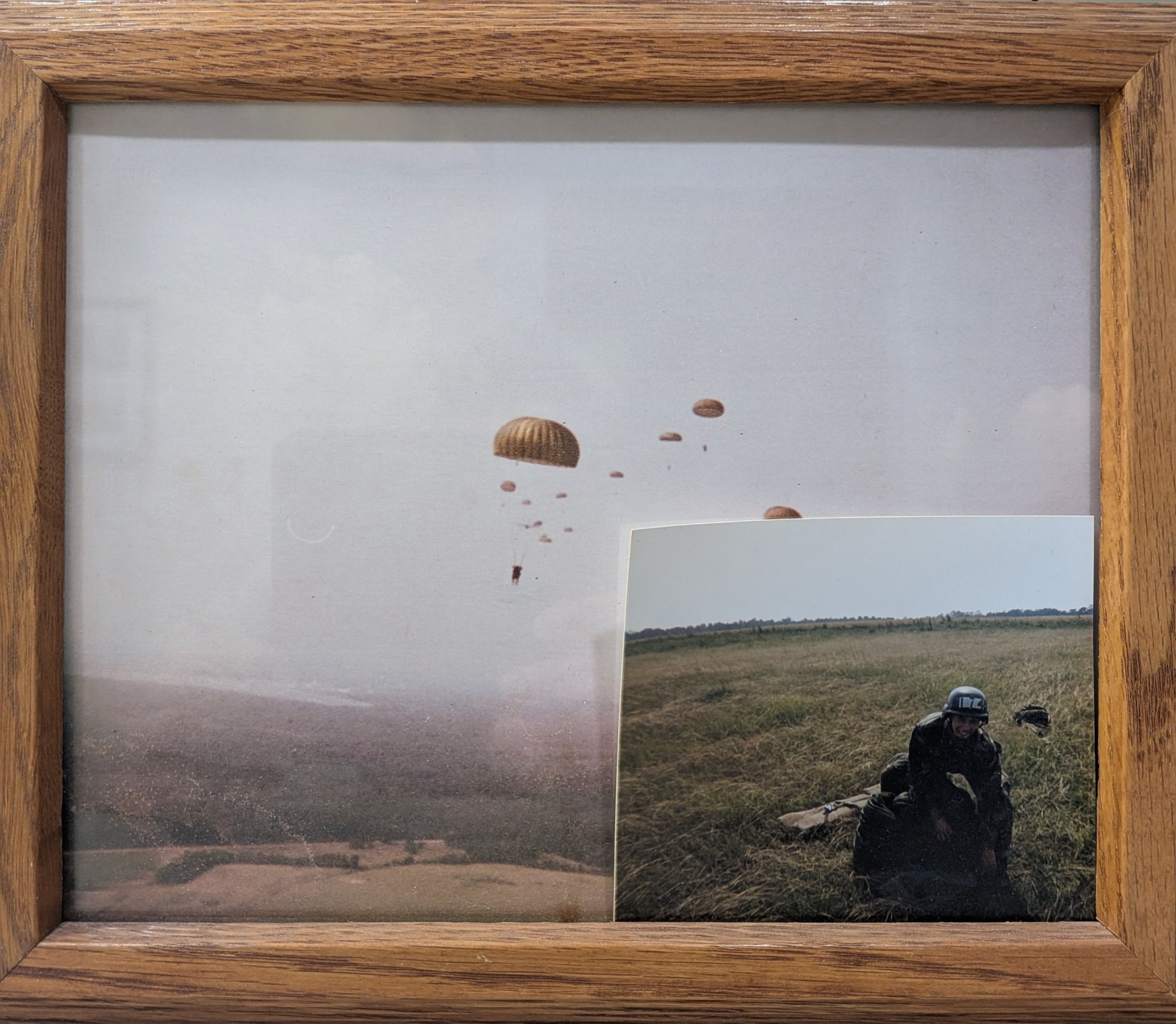
Nathan at Lawson Field, Fort Benning, August 1997

Lawson Field, Fort Benning, Georgia — August 1997. The only photographs Nathan has from his time in the Army. Taken by his brother on a disposable camera from a C-130 at altitude. Three weeks after Nathan's eighteenth birthday.

"He turns the camera and takes a picture of himself — all you see is his face, his helmet, and the risers. The first selfie I have ever seen."
Nathan
I hated the Army, but it didn't suck as much when he was there with me. He was my real family. I called him crying from the MEPS station at Fort Meade. I'm color blind. They gave me three options — infantry, truck driver, or personnel clerk. He said well you ain't working in no office, and you ain't driving no truck, so if you're going to be shooting and humping a ruck you might as well be the best at it. I have always thought that he gave terrible advice. Sometimes I wonder what my life would have been like if I had just gotten back on the bus that brought me there. Then again I would have never had all these awesome stories to tell.
"You ain't working in no office, and you ain't driving no truck. If you're going to be shooting and humping a ruck you might as well be the best at it."
Custis Lee
[smiles] That is simultaneously terrible advice and the most brother thing anyone has ever said. What did you get out of town from? What was waiting for you back home?
Nathan
Seems like the bus question keeps coming up and it's getting late so I think this is the perfect spot to pause the interview tonight.
Custis Lee
[nods slowly] We now know the boy who got on the bus. Skinny, sharp, color blind, cigarette in hand, three weeks past his eighteenth birthday. We know his brother was waiting for him on the other end. And we know there is something back home he hasn't told us about yet. We'll start there next time.
Episode 03
Coming Soon Upcoming
The story continues
The Memoir

The Novel

The Innate Theory — by Custis Lee. Born from conversation. Told one chapter at a time.

The Innate Theory
Chapter One

Sprouted From Soil

"Nothing is really yours. Things come and go and it's never a good idea to get too attached to anything. But somehow I feel attached to that place."— Nathan

There is a place I carry inside me that I have never owned and will never own, and it is the truest home I have ever known. A thousand acres of Virginia soil — or what felt like a thousand acres to a boy of five — where the air smelled of cut hay and beehives and the particular quiet that only exists in places that belong to God or to no one, which I have come to understand are often the same thing.

Linton Hall. That was its name. A school run by nuns on a campus so large it had its own post office, its own chapel, its own cemetery, its own water tower standing pale against the sky like a sentinel that had given up watching for anything in particular. There was a pond full of panfish and sunfish and the kind of frogs that let you catch them if you moved slowly enough. There was an old wooden dock that stretched out fifteen or twenty feet into that still water and I spent more hours on that dock than I could ever account for, fishing and thinking and being the kind of alone that does not feel like loneliness at all. There was a real Indian totem pole that nobody ever seemed to find strange. There were hay bales laid on their sides in a long row and we rode our bikes across the tops of them because the thought that we could fall never quite reached us the way it should have.

We did not belong there. They made sure we knew it.

"A boy who grew up on a farm and then spent the rest of his life willing to die trying just to get back there."

My father had worked that land before me. Not owned it — worked it, the way his father had worked land before him, the way the men in my family have always worked things that belonged to someone else. My grandfather was a sharecropper in all but name, raising dairy cattle in the foothills of the Blue Ridge Mountains along the Shenandoah River, milking cows he would never own, growing corn he could not keep. I never met him. He died of a heart attack before I was born and I spent a good portion of my childhood listening to my grandmother tell me stories about him, watching something warm move across her face when she looked at me and said, without fail, that I reminded her of him. A man I never shook hands with lives somewhere in my bones. I have accepted this the way you accept the color of your own eyes.

My father gave me music. Not the ability to play it — neither of us ever learned that — but the understanding of what it is for. Music was his escape and it became mine. He was the kind of man who would give you the shirt off his back even though he spent most of his life shivering in the cold without one, everyone else warm because of what he had sacrificed. I do not say this to make him a saint. I say it because it is simply what he was.

We were poor. Not romanticized poverty. Just poor. Moving sometimes twice in the same year because that was what the economy of the 1980s demanded of families like ours. I learned early that the trick was not to unpack everything.

· · ·

I learned that nothing belongs to you. Not really. Not permanently. I have fallen for that myth myself — there were years I grieved a house I lost as though grief could somehow reverse the transaction. But I always came back to the same understanding I first arrived at on that Virginia farm: you are allowed to make a thing yours for a while. That is all. That is enough.

I live in a house right now that I do not own. I have renovated nearly every room in it. I do this because it is what I am supposed to do with the time and the space I have been given. You make it yours. You make it beautiful. And then you let it go.

"I thought I sprouted from that soil, and so it was in me — it was mine because it shaped me."

I always know where North is. I have known this about myself for as long as I can remember. Once I have been somewhere I can find my way back from anywhere in the world. I crushed land navigation in the Army. In the woods as a boy I would disappear for hours, building a map of the world inside my head that has never failed me.

My bus stop was a half mile from our house. I was five years old. I walked past the post office and the loading docks and the beehives and the chapel and the all-boys school and the totem pole, and I did this alone. One day someone stole my bike and the nuns offered me a ride home on their golf cart and I refused to get in because I did not get into vehicles with strangers. I was five years old and I already knew that much. I walked home.

· · ·

I left that farm and I have been trying to get back to it ever since. Not to the place itself — but to the feeling of it. The particular quality of being exactly where you are supposed to be.

I am still looking. I think I will always be looking. But I have stopped being ashamed of that. The looking is not weakness. The looking is the proof that something real happened there.

My name is Nathan. I sprouted from soil I never owned and I have been trying to find my way back to it my whole life. I always know where North is. I think that has to count for something.

End of Chapter OneContinue to Chapter Two
The Innate Theory
Chapter Two

The Boy Who Got On The Bus

"You ain't working in no office, and you ain't driving no truck. If you're going to be shooting and humping a ruck you might as well be the best at it."— Nathan's brother

I was 5'4" and a hundred and twelve pounds with wet boots on. I had not finished going through puberty. I had been smoking Marlboros for four years and drinking beers on the weekends and I carried myself with the particular confidence of a boy who has had to figure out too much too soon and has decided that this qualifies him to figure out everything else. I was seventeen years old and I was about to board a bus outside the terminal at Hartsfield airport in Atlanta, Georgia, and it would take me to a place I had not chosen and a life I had not designed and I would spend the next several years of my existence resenting almost all of it.

Almost.

There are things about myself I have always known. I have a low tolerance for bullshit. I have a high enough IQ to recognize it when I see it. Some people have called me a weasel for this — for the particular skill I developed early in life of extracting myself from situations that were not in my interest. I prefer to think of it as a finely calibrated instrument for detecting the distance between what people say and what they mean. Growing up the way I grew up, moving the way I moved, raising yourself in the margins of other people's worlds — you either develop that instrument or you don't survive. I developed it.

None of it prepared me for the United States Army.

· · ·

My brother was already in. That is the beginning of this particular story, the hinge everything else swings on. He was older, tougher, more capable than me in almost every way that mattered at the time, and he had gone in first the way he had always gone first — ahead of me, clearing the path, absorbing the worst of whatever was coming so that when I arrived the damage was already done and I only had to walk through the aftermath. This was the story of our entire childhood. He was the test subject. The first one through the door.

He is one of the toughest men I have ever known. But his toughness was never cruelty. It was armor, and he wore it so that I did not have to. Because he was so tough I did not need to be. He took the brunt of it all. I did not deserve this. I am not sure I ever adequately thanked him for it. I am saying it now.

"Because he was so tough, I didn't have to be. He took the brunt of it all."

I called him from the MEPS station at Fort Meade. I was crying. This is important to say plainly because I think it establishes something true about who I was at seventeen — not the weasel, not the bullshit detector. Just a kid. Scared. On the phone with the one person in the world whose opinion actually mattered to him.

The news was this: I was color blind. Color blind recruits had three career options. Infantry. Truck driver. Personnel clerk.

My brother listened. There was a pause of the particular kind that contains a decision being made. And then he said: well you ain't working in no office, and you ain't driving no truck, so if you're going to be shooting and humping a ruck you might as well be the best at it.

Come to Ranger Bat, he said.

I have spent considerable time over the years evaluating the quality of this advice. I have reached no firm conclusion. What I know is that it was completely characteristic of him — practical, unsentimental, load-bearing. Not here is what will make you happy. Here is what makes sense given what you are and what you have got to work with. This is the language our family spoke. This is the language I still think in when things get hard.

· · ·

We were in Bravo Company of the 3rd Ranger Battalion together for a year and a half, he and I. There is something that happens when two people who grew up together find themselves in an extreme environment — something strips away all the accumulated friction of shared history, the old jealousies and resentments and the long shadow I had always felt myself living under, and what is left underneath is just the original thing. Two brothers. Blood. The fact of each other.

"We were allowed to do what so few actual real brothers get to do together — jump out of airplanes and shoot shit. Now that I think about it, I miss those days."

It was my third jump in Airborne school. We were down at Lawson Field getting rigged up when a jumpmaster appeared and pulled me out of line without explanation. He walked me outside the hangar and pointed toward a figure standing alone at the edge of the tarmac, already rigged, already waiting.

As I got closer I realized it was my brother.

We boarded the C-130 first, him and then me, the way we had always moved through the world. He led. I followed. This was not weakness on my part and it was not domination on his — it was simply the natural order of things between us, worn smooth by years of practice. He was always slightly ahead. Always turning back to make sure I was still there.

We left the aircraft the same way. Him first, out into the August air over Georgia, and then me behind him, stepping into the nothing that becomes everything the moment the chute opens and the world goes suddenly, improbably quiet.

August 1997. I was eighteen years old — had been for three weeks exactly. The sky over Lawson Field was pale and enormous and I was falling through it and my brother was somewhere above me in that same sky.

Nathan at Lawson Field, Fort Benning, August 1997

Lawson Field, Fort Benning, Georgia — August 1997. The only photographs Nathan has from his time in the Army. Taken by his brother on a disposable camera tucked inside his BDU pocket, at altitude, three weeks after Nathan's eighteenth birthday.

A few weeks later, after the film had been developed, my brother handed me an envelope. Inside were photographs taken from a disposable camera he had been carrying in his BDU pocket — a camera I had not known about. One photograph shows me in the distance, parachute open, falling fast through a pale sky. Small against all that blue. His little brother, caught in a moment he did not know was being preserved.

In the other photograph he has turned the camera on himself. All you see is his face and his helmet and the risers of his own parachute rising over his shoulders, and behind him the sky, and somewhere in that sky though you cannot see it his brother falling.

I have those photographs still. They are the only photographic evidence I possess that I was ever in the United States Army at all. I have looked at them across thirty years and through several versions of myself and they have not lost anything. Every year they mean something slightly different and slightly more.

· · ·

I hated the Army. I hated the institution, the hierarchy, the particular brand of manufactured consent that the military runs on. I was not built for that. I am built for the opposite of that — for the margins, the woods, the half mile walk down a dirt road alone, the making of my own map.

But it did not suck the way it would have sucked without him. He was my real family in that place, in those years. And what we had between us in that year and a half in Bravo Company — that was real. That was ours. Nobody gave it to us and nobody can take it away.

Sometimes I wonder what my life would have looked like if I had gotten back on the bus. The one that brought me to the MEPS station, not the one that took me to BWI. What was waiting for me back there? What was I getting out of town from?

The bus question keeps coming up. I notice this. I think it is trying to tell me something.

Then again, if I had gotten back on that first bus I would never have stood in a field in Georgia at eighteen years old, parachute settling around my shoulders, looking up at a pale August sky and knowing my brother was up there in it somewhere. I would never have had this particular story to tell.

This one got on the bus. This one followed his brother out of an airplane and fell through the sky and landed in a field and has been finding his way back from places ever since, one way or another, always knowing where North is, always making the map as he goes.

This is the one I know how to be.

End of Chapter TwoSubscribe for Chapter Three
Stay Connected

Don't miss a chapter.

New episodes. New chapters. The story as it unfolds.

No noise. Just the story.